Institute for New Generation Computer Technology
4-28, Mita 1-chome, Minato-ku, Tokyo 108, Japan
{nitta, kyokota, aiba, ishikawa}@icot.or.jp
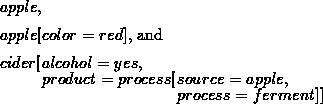
An oid is in the form of a tuple called an object term. For example,
apple,
apple[color = red], and
cider[alcohol = yes,
      product = process[source = apple,
                        process = ferment]]
	if assumptions then  answer because explanation,
	if  hypotheses then ?-query
		(written as ?-query;;hypotheses).
&environment n-queens;
      &common_type common-type-file:
      &agent_dir   queen-1, queen-2, queen-3,
                   queen-4, queen-5, queen-6,
                   queen-7, queen-8;
&type      simple;
¶meter ID:int = 1;
&agent     queen1;
&env       n-Queen, nQ.env;
&inside    prolog
           &sub /app/nQueen/lib/queen-pr.pl;
&substance_type prolog
&connection pipe;
&import_method
  solve_n_queens @ #1:int -> #2:[position]
    =>
    n_queens @ #ID:INT, #1:INT, #2:[POSITION];
                           ...


&export_method
   get_my_domain @ #1:position -> #2:positions
   <=
   bag_of!get_others_positions @ #1:POSITION,
                                 #3:INT,
                               [#2]:[POSITIONS];
                           ...

&convert
  (id-#1,position=#2):position
                  <-> [#1,#2]:POSITION;
  (id-#1,position=#2):positions
                  <-> [#1,#2]:POSITIONS;

&self_model
  &function 4queens, 5queens, 6queens,
            7queens, 8queens;
are object terms, where the first term is basic, but the latter two are complex.